
Do Pedestrians Have the Right of Way at an Unmarked Crosswalk in Washington?
Yes. A legal crosswalk exists at nearly every Washington intersection, whether or not there is paint on the pavement, and drivers must stop and stay stopped for a person crossing in one.
- Washington defines a crosswalk by the geometry of the intersection, not by the markings.
- A driver must stop when a person is on their half of the road or within one lane of it.
- Passing a vehicle already stopped at a crosswalk is prohibited.
- A few specific locations are exceptions, and those exceptions are narrow.
Whether a particular crossing qualifies is a factual question that turns on measurements, so it is worth checking rather than assuming.
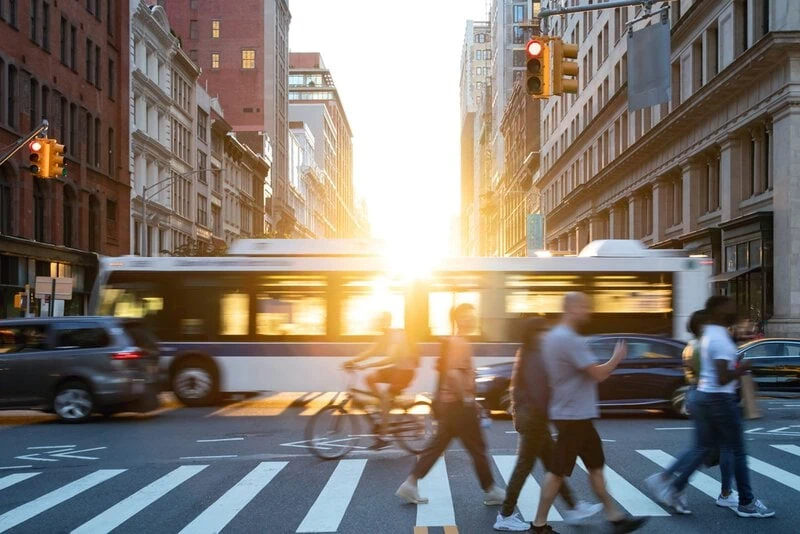
Unmarked crosswalk right-of-way in Washington is one of the most misunderstood rules on the road, and the misunderstanding costs injured people money. A driver tells the officer the pedestrian "came out of nowhere, there wasn't even a crosswalk there." The adjuster repeats it. Nobody checks the statute.
The statute says something different. If you were hit crossing at an intersection with no painted lines, a Seattle pedestrian accident attorney at Pendergast Law can establish what the law actually protected. Call our Seattle office at (206) 620-0707 for a free consultation.
SCHEDULE A CONSULTATIONKey Takeaways about Unmarked Crosswalk Right-of-Way Rules in Washington
- Washington's statutory definition of a crosswalk covers unmarked intersection crossings, not only painted ones.
- Where no sidewalk exists, the crosswalk extends to a line 10 feet from the intersection area.
- Drivers must stop and remain stopped, and may not overtake a vehicle already stopped for a pedestrian.
- Exceptions exist for signed crossings, tunnels or overhead crossings, and stretches between adjacent signalized intersections.
- Shared fault reduces a recovery under Washington's pure comparative fault rule instead of ending a claim.
What Counts as an Unmarked Crosswalk Under Washington Law?
An unmarked crosswalk is a matter of definition, not paint. RCW 46.04.160 defines a crosswalk as the portion of roadway between the intersection area and a prolongation or connection of the farthest sidewalk line. Where there are no sidewalks, it runs between the intersection area and a line 10 feet from it.
Read plainly, the sidewalk you were standing on projects across the street, and that projection is your crosswalk. It exists on every leg of the intersection, in both directions, without anyone painting anything.
How That Looks on a Seattle Street
Seattle applies the same logic in its municipal code, which is useful because the city publishes it. The Seattle Streets Illustrated standards describe legal crosswalks at intersections as defined by projections of the curb and back-of-sidewalk lines across the street, or by a line 10 feet behind the curb face where no sidewalk exists.
The practical consequence is a crossing zone wider than most people picture. It reaches from the curb line back to the far edge of the sidewalk, which on a typical Capitol Hill or Ballard corner is a substantial band of pavement.
What a Driver Must Do at an Unmarked Crosswalk
Stop, and stay stopped. Under RCW 46.61.235, the operator of an approaching vehicle shall stop and remain stopped to allow a pedestrian to cross within a marked or unmarked crosswalk when the pedestrian is upon, or within one lane of, the half of the roadway the vehicle is traveling on or turning onto.
The statute adds a rule that decides a great many of these cases. When a vehicle is stopped at a crosswalk to let someone cross, a driver approaching from behind may not overtake and pass it.
Separately, RCW 46.61.245 requires every driver to exercise due care to avoid colliding with any pedestrian on any roadway and to sound the horn when necessary. That duty does not switch off between intersections.
SCHEDULE A CONSULTATIONWhere the Right of Way Ends
The protections are strong but not unlimited, and knowing the exceptions is part of evaluating a claim honestly.
- Suddenly leaving the curb. RCW 46.61.235 provides that no pedestrian shall leave a curb or place of safety and move into the path of a vehicle so close that stopping is impossible.
- Signed prohibitions. Under RCW 46.61.240, crossing at an unmarked crosswalk is prohibited where an official sign says so.
- Between adjacent signals. Between adjacent intersections with traffic control signals in operation, pedestrians must cross at a crosswalk.
- Tunnels and overhead crossings. Where a pedestrian tunnel or overhead crossing is provided, a pedestrian crossing the roadway instead yields to vehicles.
- Mid-block crossings. Outside a marked or unmarked crosswalk, the pedestrian yields, though the driver's due care duty remains.
Even where an exception applies, yielding and fault are different questions, and a driver who was not looking still bears responsibility for that.
Why Do Insurers Call These Crossings Jaywalking?
Because it works, unless someone corrects it. The word "jaywalking" appears in no Washington statute, and it functions in a claim file as a substitute for legal analysis.
In our experience handling pedestrian claims across King County, the sequence is consistent. An officer arrives at a corner with no paint, hears the driver's version first, and notes an unclear crossing. The adjuster reads "no crosswalk" and opens negotiations from a position the statute does not support.
What corrects it is measurement rather than argument. Establishing where the sidewalk lines run, where the intersection area begins, and where you were standing converts an assumption into a fact.
How Does Shared Fault Work in an Unmarked Crosswalk Claim?
It reduces a recovery by a percentage and nothing more. Washington applies pure comparative fault under RCW 4.22.005, under which contributory fault chargeable to a claimant diminishes compensatory damages proportionately but does not bar recovery.
There is no cutoff in this state. A pedestrian assigned 30% of the fault recovers 70% of proven damages, which means the fight over each percentage point has a dollar value.
Insurers know this, which is why the initial fault theory usually arrives inflated. Pushing it back down early, before an offer is anchored, is most of the work.
Proving the Crosswalk Was There
We treat the crosswalk as something to demonstrate, not assert. That means going back to the corner with a tape measure and a camera rather than relying on a diagram someone sketched at the scene.
On an unmarked crossing case, our work typically includes:
- Measuring the sidewalk lines and their prolongation across the roadway
- Documenting the intersection area and the 10-foot line where no sidewalk exists
- Photographing the driver's approach from their eye height in comparable light and weather
- Checking for any official sign that would trigger an exception, and photographing its absence
- Pulling business, transit and residential camera footage before retention windows close
- Reviewing the driver's conduct independently, including speed, phone records and signal use
That package is what moves a claim from one person's word against another's into a documented position. The same principles run through Washington right-of-way rules generally, and unmarked crossing collisions often develop alongside Seattle car accident claims involving turning traffic.
SCHEDULE A CONSULTATIONFAQs about Unmarked Crosswalk Right of Way in Washington
These are the questions injured pedestrians ask us most often about crossings without paint.
Does an unmarked crosswalk exist at a T-intersection?
Generally, yes, on the legs where the geometry supports it. The statutory definition turns on the intersection area and sidewalk lines rather than the number of approaches, so a T-intersection can have unmarked crosswalks.
What if the corner has no sidewalk at all?
The statute accounts for that. Where no sidewalks exist, the crosswalk runs between the intersection area and a line 10 feet from it, which preserves a crossing zone on rural and unimproved streets.
Can a city remove an unmarked crosswalk?
Only by signing it closed. Since unmarked crosswalks arise from the definition rather than from markings, they exist unless an official sign prohibits crossing at that location.
Does a driver have to stop for someone still on the curb?
The duty attaches when the person is upon the roadway or within one lane of the driver's half of it. Standing at the curb waiting is not yet the trigger, which is a distinction insurers rely on and video often resolves.
I was hit while walking my bike across. Does that change anything?
RCW 46.61.235 expressly covers bicycles crossing within a marked or unmarked crosswalk, and a cyclist on a sidewalk or crosswalk carries pedestrian rights and duties. Walking a bike keeps you squarely in pedestrian territory.
The police report blames me. Is my claim over?
No. A police report is evidence, not a verdict, and officers reach conclusions quickly without measurements or video. Fault findings are frequently revised once the geometry of the crossing is established.
What does it cost to have my crossing reviewed?
Nothing. Consultations are free, we take these cases on contingency, and we do not get paid until you do.
Talk With Our Team About Your Seattle Crossing
You crossed at a corner your city treats as a legal crossing, and a driver did not stop. The absence of paint should not decide what happens to you next.
We have recovered more than $100 million for injured people across Washington, and Pendergast Law is available 24/7 from our Seattle, Renton, and Tacoma offices. Born here, raised here, staying here.
Call our Seattle office at (206) 620-0707 or reach us through our online contact form for a free case review.
SCHEDULE A CONSULTATION