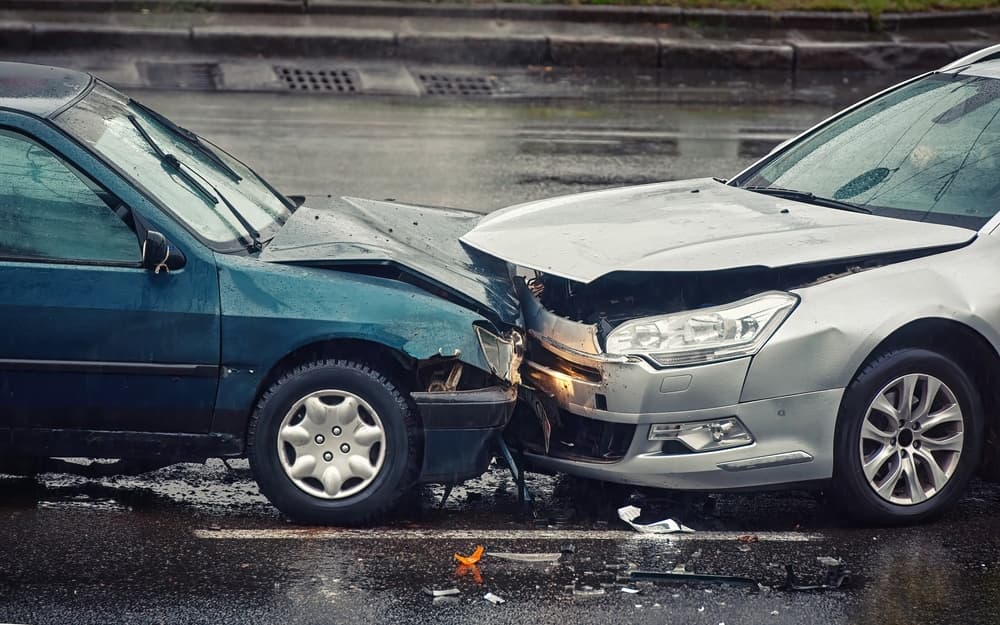
When a vehicle crosses the double yellow line and strikes your car head-on, the legal fault seems obvious. Under Washington law, the driver who crosses that center line is immediately presumed to be negligent. This concept, called negligence per se, is tied directly to statutes like RCW 46.61.100, which requires all vehicles to stay on the right half of the roadway. The law starts on your side.
But a legal presumption is not a guarantee. The other driver’s insurance carrier may argue that their client faced a sudden emergency, such as a medical event, a deer in the road, or a sudden mechanical failure, to shift the blame. They will also scrutinize your actions, looking for any reason to assign you a portion of the fault, even if you were completely in your own lane.
If you have a question about a head-on collision or a crossover accident in Washington, call our Seattle car accident lawyer. We offer a free consultation, and there is no obligation to work with us.
Key Takeaways for Centerline Crossover Accidents
- The driver crossing the centerline is presumed negligent. Washington law starts on your side, but the other driver's insurance will still fight to shift blame using defenses like a sudden emergency.
- Government entities might share liability. If poor road design, lack of rumble strips, or bad drainage contributed to the crash, the state or county could also be held responsible for your injuries.
- Your own insurance is a crucial safety net. Because head-on collisions cause severe injuries, damages frequently exceed the at-fault driver's policy limits, making your Underinsured Motorist (UIM) coverage essential for a full recovery.
The Anatomy of a Crossover: Why River Roads Are Deadly
Washington is known for its scenic River Roads, which are winding, two-lane rural routes that trace the paths of rivers such as the Snohomish, Skagit, or Green. Highways like SR-2, SR-9, and SR-512 are beautiful, but they are unforgiving. Many lack median barriers, leaving nothing but a few feet and two painted lines to separate you from oncoming traffic traveling at 50 or 60 miles per hour.
Because the vehicles are moving toward each other, their closing speed effectively doubles the force of a head-on impact. A head-on crash where both cars are traveling 50 mph is equivalent to hitting a stationary wall at 100 mph.
While head-on collisions are relatively rare, they are disproportionately deadly. The focus of any legal investigation must be to determine exactly why the other driver crossed into your lane. Was it a slow lane drift caused by drowsiness or distraction, or a sudden loss of control from speeding or hydroplaning on a wet road? The answer dictates the path to establishing liability.
Washington’s notorious rain adds another layer of danger. Water pooling in the ruts worn into older asphalt on state routes frequently causes vehicles to hydroplane, and a momentary loss of traction is all it takes for a driver to lose control and veer across the centerline.
Establishing Driver Liability: Negligence Per Se and RCW 46.61
You know what happened: another car entered your lane and hit you. Yet, to secure compensation, you must prove the other driver was legally negligent.
The defense will likely search for a way to excuse their driver's actions, in some cases turning to the Emergency Doctrine. This legal concept argues that a person shouldn't be held to the same standard of reasonable care when faced with a sudden, unexpected peril not of their own making. They might claim a tire suddenly blew out, a phantom vehicle swerved into their lane, or they had an unforeseen medical crisis.
This is where Washington’s traffic safety laws become your strongest tool. The legal principle of negligence per se means that if a person violates a statute designed to protect public safety, that violation is considered proof of negligence in itself. The simple act of crossing the double yellow lines in violation of RCW 46.61.100 is a breach of the law. The same applies to RCW 46.61.125, which prohibits driving to the left of the centerline when approaching a curve or the crest of a hill.
When negligence per se applies, the burden of proof effectively shifts. It is no longer your job to prove the other driver was careless; it becomes their job to prove they had a legally valid excuse for breaking the law. And that is a very high bar to clear. Even if an obstacle was present, every driver has a Duty of Care to react reasonably. Swerving into a lane of oncoming traffic is almost never considered a reasonable response when braking or steering onto a shoulder were available options.
When the Road Is to Blame: Municipal and State Liability
Sometimes, the driver isn't the only party at fault. A careful investigation might reveal that the condition of the road itself was a contributing factor. Washington's roads are aging, and a design flaw or lack of maintenance could lead directly to a centerline crossover head-on.
Historically, you couldn't sue the government under a doctrine called sovereign immunity. However, Washington has waived this immunity, which means you can bring a claim against the Washington State Department of Transportation (WSDOT), a county, or a city if a dangerous road condition caused or contributed to your injuries.
Common road defects that contribute to crossover collisions include:
- Lack of Rumble Strips: A 2011 WSDOT study shows that centerline rumble strips are highly effective at preventing crossover crashes by alerting inattentive or drowsy drivers. If a stretch of highway had a known history of head-on collisions and the state failed to install this low-cost safety feature, WSDOT could share in the liability.
- Poor Drainage and Hydroplaning: If a road is improperly graded or drains are clogged, water can pool on the surface. If the government entity was aware of this recurring hazardous condition and did nothing to fix it, they may be held responsible for hydroplaning-related collisions.
- Signage Failures or Confusing Design: Poorly marked curves, faded lane markings, or confusing interchange designs can cause driver error. For example, some modern roundabout conversions have led to drivers becoming confused and entering the highway going the wrong way, leading to a devastating head-on collision.
If you suspect a road defect played a role in your collision, you must act quickly. Claims against government entities in Washington have much shorter deadlines than standard personal injury lawsuits. You must first file a specific Tort Claim Form with the correct agency before you can proceed with a lawsuit.
Defeating the Sudden Emergency Defense
As mentioned, the most common way for an at-fault driver to escape liability in a crossover case is to claim a sudden emergency. However, we could dismantle this defense by asking one simple question: was the emergency truly unforeseeable?
The rebuttal typically comes down to these key points:
- Foreseeability of Medical Events: If the driver who truly suffered a medical event had a known pre-existing condition, such as a seizure disorder, and had been advised by their doctor not to drive or had failed to take prescribed medication, the emergency was no longer sudden or unforeseeable. It was a predictable outcome of their own negligence.
- Negligent Maintenance: A claim of mechanical failure is only a valid defense if the failure was truly sudden and unexpected. If an investigation reveals the vehicle had dangerously worn tires (a common factor in Washington rain crashes) or the brakes had not been properly maintained, the failure is a direct result of the owner's negligence, not a random accident.
In some cases, the legal doctrine of res ipsa loquitur may apply. This is a Latin phrase that means "the thing speaks for itself." It is used in situations where an event would not ordinarily happen without negligence.
Cars, when properly maintained and operated, do not simply swerve across a centerline into oncoming traffic on their own. If the defense cannot produce credible evidence of a genuine, unforeseeable external cause, the law infers that the driver’s own negligence must be the reason.
Calculating Damages in Catastrophic Head-On Cases
Head-on collisions produce some of the most severe injuries in traffic law: traumatic brain injuries (TBIs), spinal cord damage, crush injuries requiring amputation, and internal organ damage. Calculating full compensation requires projecting costs not just for immediate medical care, but for years or decades of rehabilitation, lost earning capacity, and diminished quality of life.
What If You Were Partially at Fault?
Many victims worry that their own actions will disqualify them from recovering anything. Washington law says otherwise.
Under RCW 4.22.005, Washington operates under Pure Comparative Fault. This means you can recover damages even if you were partially responsible for the collision. Your compensation is reduced by your percentage of fault, but you're not barred from recovery entirely.
When Damages Exceed the At-Fault Driver's Policy Limits
Catastrophic injuries frequently produce medical bills and lost income that exceed what the other driver's insurance will cover. Washington's minimum liability coverage is only $25,000 per person—nowhere near enough for a serious head-on collision.
This is where your own Underinsured Motorist (UIM) coverage becomes your lifeline. UIM pays the difference between the at-fault driver's policy limits and your actual damages, up to your own coverage limits. We investigate all available sources of recovery, including:
- Stacking UIM policies from multiple vehicles in your household
- Umbrella policies that provide additional liability coverage
- Commercial policies if the at-fault driver was working at the time of the crash
Carrying adequate UIM coverage is one of the most important financial decisions you can make before an accident happens.
FAQ for Centerline Crossover Accidents
The other driver died in the crash; can I still claim damages?
Yes. When a person passes away, their legal and financial obligations transfer to their estate. You would file a claim against the deceased driver's auto insurance policy as you normally would. If a lawsuit is necessary, it is filed against the personal representative of the driver's estate.
What if the police report says "cause unknown" regarding why they crossed the line?
A police report is just one piece of evidence, and it is not the final word. The officer's primary job at the scene is to secure the area and render aid, not perform a detailed forensic analysis. We work with independent accident reconstructionists who could analyze physical evidence from the vehicles and the scene. Furthermore, we could secure a court order to download the data from the vehicle's EDR, or black box, which records speed, braking, and steering inputs in the seconds before impact.
The other driver claimed they hydroplaned on standing water. Is that a valid defense?
Generally, no. Every driver has a legal duty to operate their vehicle at a speed that is safe for the current conditions. If the road is wet and visibility is poor, drivers are required to slow down. Hydroplaning is usually an indicator that the driver was traveling too fast for the conditions, which is a form of negligence itself, not an excuse for it.
Can a passenger in the car that crossed the centerline sue their own driver?
Absolutely. A passenger has the right to bring a claim for negligence against the driver of the vehicle they were in. Navigating insurance in this situation can be complicated, especially if the driver is a family member, as some policies contain family member exclusion clauses. However, these are complicated issues that are sometimes resolved in the passenger's favor.
How long do I have to file a lawsuit for a head-on collision in Washington?
For a personal injury claim against a private citizen, the statute of limitations in Washington is generally three years from the date of the collision. As mentioned previously, if you believe a government entity like WSDOT is partially responsible, the deadlines are much shorter, and you must file a formal tort claim notice long before the three-year deadline.
Reclaim Your Life After the Impact

If a driver crossed the centerline, Washington law presumes they were in the wrong, and it is their and their insurance company's responsibility to prove otherwise.
Do not accept an insurance adjuster's quick explanation that a sudden emergency absolves their driver of all responsibility. These are standard defense tactics used to discourage you or devalue your valid claim. You have the right to demand proof.
We have experience dissecting the physics and legalities of crossover collisions. Call Pendergast Law today for a free consultation to begin the process of securing the resources you need for your recovery.